Adinkra symbols and their meanings: a guide to 20 Akan symbols
What Adinkra symbols are, where they come from, how the stamped cloth is made in Ghana, and what twenty of the best-known symbols mean, from Gye Nyame and Sankofa to the ram's horns.
Adinkra symbols are visual symbols of the Akan people of Ghana, each representing a proverb, value or idea. Gye Nyame ("except God") stands for the supremacy of God, Sankofa ("go back and get it") for learning from the past, and Dwennimmen (ram's horns) for strength with humility. Traditionally the symbols are stamped by hand onto cloth with carved calabash stamps and a dye made from tree bark.
What Adinkra symbols are
Adinkra symbols come from the Akan people of Ghana, and each one stands for a concept or a saying. Many are tied to specific proverbs, so a single symbol can carry a whole piece of traditional wisdom about faith, leadership, family or how to live. The philosopher Kwame Anthony Appiah described them as one of the ways a complex body of belief and practice was passed from one generation to the next.
In the Akan language, Twi, the word adinkra originally referred to a type of cloth rather than to the symbols themselves. Today the symbols appear far beyond textiles: on pottery, carved stools, the brass weights once used to measure gold, walls and buildings, jewelry and clothing around the world.
Where Adinkra comes from
One well-known oral tradition says Adinkra came from the kingdom of Gyaman, whose king, Kofi Adinkra, was defeated by the Asante, who then adopted his cloth and its symbols. Historians have shown that story can't be the whole picture. The war it describes took place in 1818 and 1819, but in 1817 the English visitor Thomas Bowdich saw Adinkra cloth being made in Kumasi, the Asante capital, and brought a piece back with him.
That cloth, made in 1817, is the oldest surviving Adinkra textile and is now in the British Museum. It is stamped with fifteen symbols, including stars, double drums and diamonds. Some accounts suggest the stamped cloth existed under another name, ntiamu ntoma ("stamped cloth"), and only became associated with the name Adinkra after the war. In the weaving and stamping towns of Asokwa and Ntonso, it is still sometimes called by that older name. The exact origin remains unclear, but the symbols have been central to Akan culture for at least two centuries.
How Adinkra cloth is made
The traditional center of Adinkra cloth production is Ntonso, about 20 kilometers northwest of Kumasi. The process has three parts:
- The dye. The inner bark and roots of the badie tree are soaked, pounded and boiled over a wood fire, then strained and boiled again for hours until the liquid thickens into a dark pigment called adinkra aduro.
- The stamps. Each symbol is carved into a piece of calabash gourd, usually five to eight centimeters across, with a handle on the back. The stamp is slightly curved so the dye can be applied with a rocking motion.
- The cloth. The cloth is often divided into squares by lines, and the stamper fills each square with a repeated symbol, building up a pattern by hand.
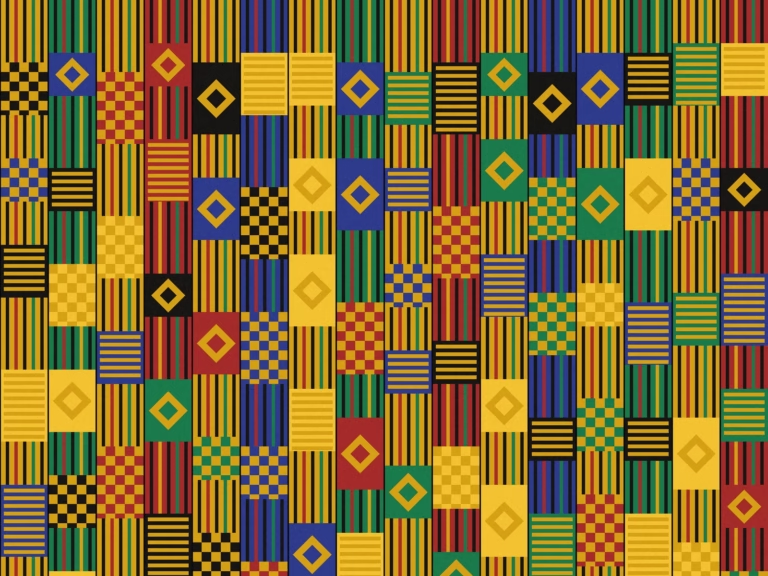
Adinkra cloth was traditionally worn by royalty and spiritual leaders at funerals and other very important occasions, and the color of the base cloth depended on the occasion and the wearer's role: undyed, red, dark brown or black. Today Adinkra designs are also mass-produced on brighter fabrics and worn far more widely.
20 Adinkra symbols and their meanings
There are well over a hundred Adinkra symbols, and interpretations vary between sources and regions. These twenty are among the most widely recognized, with the meanings most commonly given.
Faith and the divine
- Gye Nyame"Except God"The supremacy of God; fear none but God. The most popular Adinkra symbol in Ghana.
- Nyame Dua"Tree of God" or altarGod's presence and protection. It represents the altar where offerings to God were placed.
- Nsoromma"Child of the heavens," a starFaith and guardianship: like a star, a child of God rests on God rather than on themselves.
Wisdom and learning
- Sankofa"Go back and get it"Learning from the past to build the future: it is not wrong to return for what you left behind. Drawn as a bird looking backward or as a curled heart.
- Mate Masie"I have heard and kept it"Wisdom, knowledge and prudence, including the value of keeping a confidence.
- Dame-DameA board gameIntelligence and ingenuity.
- Nkyinkyim"Twisting"Initiative, dynamism and versatility: life's path twists and turns, and you adapt.
Strength and leadership
- Adinkrahene"Chief of the Adinkra symbols"Greatness, charisma and leadership. Its concentric circles are said to have inspired many other designs.
- Dwennimmen"Ram's horns"Strength combined with humility: the ram fights fiercely but submits when it must.
- Aya"The fern"Endurance and resourcefulness. The word can also mean "I am not afraid of you."
- Akoben"War horn"Vigilance and readiness, from the horn sounded to call warriors.
- Hye Won Hye"That which does not burn"Toughness, endurance and the ability to withstand hardship.
- Owo Foro Adobe"A snake climbs the raffia palm"Accomplishing what seems impossible, and staying quiet about it.
Love, unity and community
- Akoma"The heart"Patience, tolerance and endurance; to "have a heart" in Akan is to be patient.
- Akoma Ntoso"Joined hearts"Understanding, agreement and unity.
- Osram ne Nsoromma"The moon and the star"Love, faithfulness and harmony, often linked to the bond of marriage.
- Bi Nka Bi"No one should bite another"Peace and harmony; a warning against provoking conflict.
- Funtunfunefu Denkyemfunefu"Siamese crocodiles"Two crocodiles share one stomach yet fight over food: unity in diversity, and the folly of fighting over what you share.
- Nkonsonkonson"Links of a chain"Unity, human relations and contributing to the community.
- Eban"Fence"Love, safety and security: the fence that protects the home.
Wearing Adinkra symbols
Adinkra symbols work in menswear in several ways: as hand-stamped cloth worn traditionally, as prints on Ankara and other fabrics, and as embroidered details on a Senator top, placket or pocket. Because each symbol carries a message, they're a way to make a piece personal.
- Choose by meaning. Akoma Ntoso or Osram ne Nsoromma suit a wedding; Adinkrahene or Dwennimmen speak to leadership; Sankofa marks a milestone or a return to your roots.
- Respect the context. Traditional Adinkra cloth is closely associated with mourning, and Gye Nyame and Nyame Dua carry religious meaning. Learn what a symbol means before you wear it.
- Keep it intentional. One meaningful symbol, well placed, says more than a scatter of motifs chosen only for their look.
If you'd like a symbol worked into a custom piece, ask Joshua when you order. For how Adinkra fits alongside Kente, aso-oke and other textiles, see African patterns and their meanings, and for wearing African symbols respectfully, read Can White Men Wear African Prints?
Make it yours. Joshua makes Senator sets, Agbada, Kaftans and Ankara pieces to measure, in the fabric and colors you choose. See how custom ordering works, or message him on WhatsApp using the button below.
Adinkra questions, answered
What is the most popular Adinkra symbol?
Gye Nyame, meaning "except God," is the most popular Adinkra symbol in Ghana. It represents the supremacy of God.
What does Sankofa mean?
Sankofa means "go back and get it." It stands for learning from the past to build the future, and is drawn as a bird looking backward or as a curled heart shape.
Where do Adinkra symbols come from?
Adinkra symbols come from the Akan people of Ghana. Oral tradition links them to the kingdom of Gyaman, but Adinkra cloth was already being made in Kumasi by 1817, and the oldest surviving example from that year is in the British Museum.
How is Adinkra cloth made?
Symbols are carved into calabash gourd stamps, dipped in a dark dye made by boiling the bark and roots of the badie tree, and pressed onto cloth by hand. Ntonso, near Kumasi, is the traditional center of production.
Can I wear Adinkra symbols?
Adinkra symbols are widely worn, including outside Ghana. Learn what a symbol means first, since some carry religious or funeral significance, and choose ones whose message you want to share.
Sources include published research on Adinkra cloth symbols of the Akan, the British Museum's 1817 Adinkra cloth, and collection notes on Adinkra production in Ntonso. Symbol meanings vary between sources; those given here are the most widely cited.